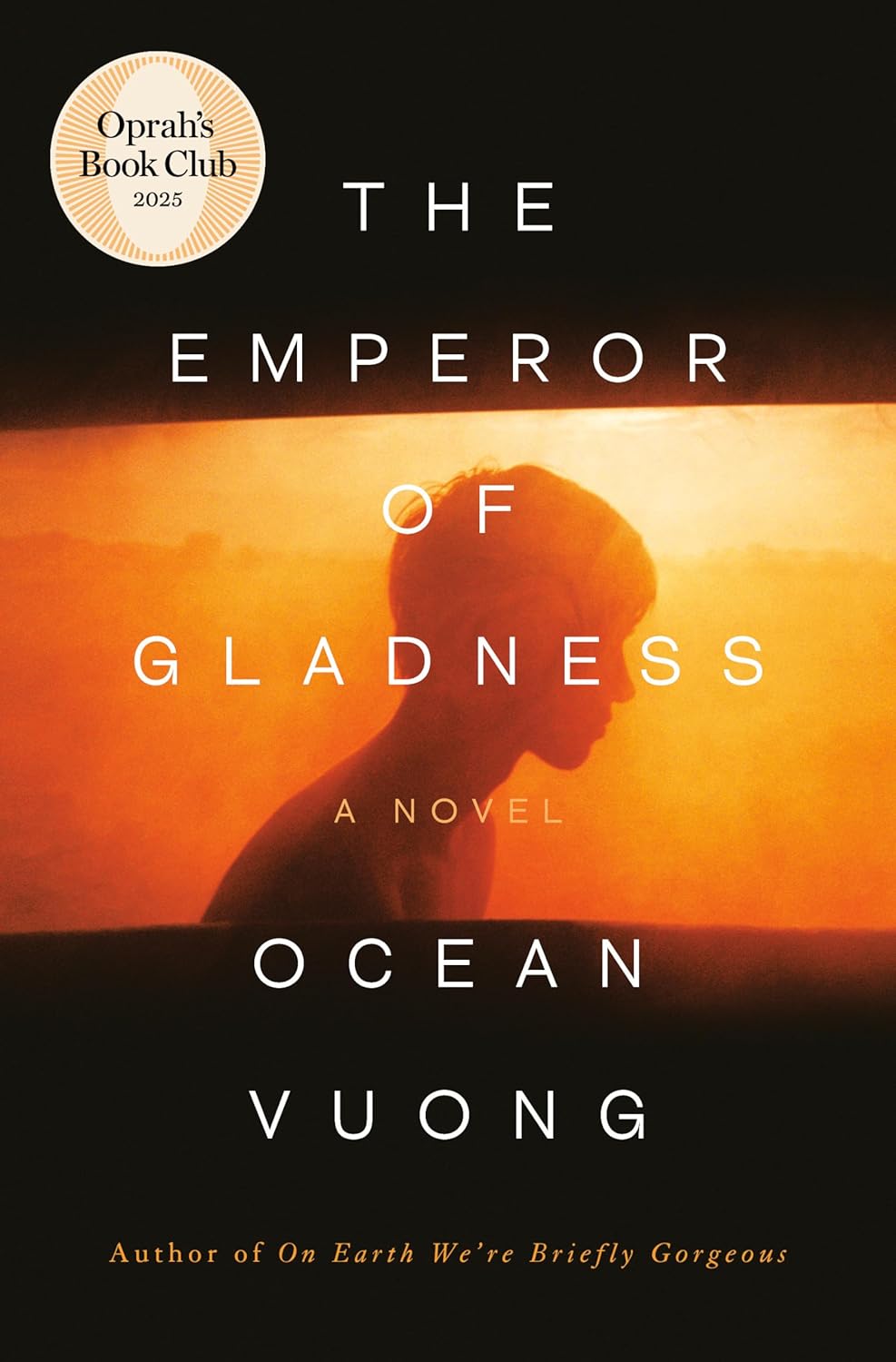
The Emperor of Gladness by Ocean Vuong
It is revealed somewhere just before halfway through The Emperor of Gladness, Ocean Vuong’s latest novel, what the secret ingredient in BJ’s famous cornbread is. BJ is the manager of the East Gladness branch of the fast-casual, always-thanksgiving, red roofed restaurant chain, HomeMarket. She runs a tight ship, taking pride in her work while also hoping her amateur wrestling act might go pro. And the secret of her cornbread is that it is cake.
“Listen, we deceive people by calling this bread. Bread sounds wholesome. You tell the public this is boring old bread, but then it hits their tongues and–boom–it’s cake! And even if it’s the shittiest kind of cake, which it is, they’d think they’ve eaten the best bread in the world. […] But the question is […] At what point, my friend, does the corn bread become corn cake? Can you locate the crumb where this deception happens.”
I was rather struck by this revelation, because if you swapped “bread” for “literature”, then you might be tempted to level the accusation at the novel. To accuse it of lacing itself with something sugary and unwholesome and unsatisfying, something artificial and cheap, in order to pass it off to an under-discerning public who might pick up this book, much like the diners at HomeMarket eagerly consume the food they are served, without understanding that they are consuming reheated pap from industrially packaged plastic sacks.
The protagonist of The Emperor of Gladness is Hai, a first generation Vietnamese immigrant to America. He is a queer college dropout who is addicted to pills and ready to throw his body and life off a bridge to be swallowed up by the cold river below. He does not. He is talked down by an elderly lady, Grazina, who invites him to live with her so that he does not have to return home to his mother who thinks he is off in Boston, at medical school. He soon finds himself in the role of her carer, taking the place of the nurses assigned to her by the state, but who never appear. And when her funds are insufficient to cover the costs of feeding them the cheap ready meals she favors, he finds work at the HomeMarket where BJ and Grazina are merely two of the many clearly delineated characters he will meet.
Most of the novel is split between his relationship to Grazina, whose mental state is rapidly deteriorating, and his life with his coworkers at the HomeMarket. For those who want to argue that this novel is laced with cake, then there is plenty examine in the crumb. There is a sentimentality to the characters that Vuong presents. Everyone has a tragic dimension and everyone is found to be beautiful. There are gnomic fragments such as the opening line: “The hardest thing in the world is to only live once”. Vuong owes some heavy literary debt. When decribing the culinary arrangement of the HomeMarket menu, we are getting a full force David Foster Wallace pastiche: “All this was mixed with the artificial flavors and aromas wafting from the vats of industrially produced food: diacetyle, acetylpropionyl, acetoin, and hydroxybenzoic acid, along with the metallic scent of colorings like Sunset Yellow FCF, tartrazine, Patent Blue V, and Green 3.” This reads like the pharmaceutical inventories that clogged up the footnotes of Infinite Jest, and if Vuong is making some parallel between them and food additives, then I think the point seems a little glib.
I think the cake accusation is not completely untrue, but misguided. Vuong has essentially combined up-lit with the trauma plot in a particular kind of way. The characters can be broad, and the humor of goofy and sitcom adjacent, but that is a perfectly legitimate strategy in that chess game we call writing a modern literary novel. For those who do not keep up with what we must now accept is current literary discourse, Vuong has been getting blowback. There are some really vicious reviews, that to anyone who is only familiar with the novel, it must surely seem utterly deranged. As far as I can see this is in large part an extra-textual imbroglio. There are entire cohorts of American writers out there who resent someone getting a MacArthur “Genius” grant for cornbread laced with cake.